
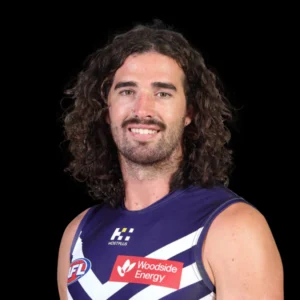
 In a development that has stunned fans, commentators, and players across the Australian sporting landscape, the Fremantle Dockers confirmed today that club captain **Alex Pearce has been suspended indefinitely from all competitive sport** as part of what officials are calling an *“unprecedented leadership and governance experiment”* jointly approved by the AFL and the AFL Players Association.
The announcement, delivered via a carefully worded statement early this morning, immediately sent shockwaves through the football world—not because of misconduct or controversy, but because of the **extraordinary and unconventional reason** behind the decision.
According to the statement, Pearce’s suspension is **not disciplinary**, **not medical**, and **not performance-related**. Instead, it stems from a groundbreaking trial designed to explore how elite sporting organisations can better support long-term athlete leadership, mental sustainability, and post-career transition planning.
### A Suspension Without Scandal
In an era where the word “suspension” often signals controversy, the Dockers were quick to stress that Pearce has done **nothing wrong**.
> “This is not a punishment,” said Fremantle CEO Simon Garlick. “Alex has been exemplary as a leader, teammate, and professional. This decision reflects the opposite—it’s because of the respect he commands across the league.”
Under the terms of the experiment, Pearce will step away indefinitely from all on-field competition while remaining actively involved in the sport through mentoring, governance observation, and strategic leadership development. The timeline for his return is intentionally open-ended.
The idea reportedly emerged from a confidential AFL summit held late last year, where club executives, sports psychologists, and former players discussed the growing pressures placed on modern team captains. Internal research presented at the summit suggested that captains often shoulder an unsustainable emotional and strategic burden, particularly in rebuilding clubs.
Alex Pearce, widely regarded as one of the most thoughtful and resilient leaders in the AFL, was identified as the ideal candidate to pilot the initiative.
> “Alex represents the modern captain,” said an AFL spokesperson. “Articulate, values-driven, emotionally intelligent, and deeply committed to club culture. This trial is about learning, not sidelining.”
### What the “Indefinite Suspension” Actually Means
Despite the dramatic headline, Pearce’s suspension does not resemble a traditional ban. He will:
* Continue attending Fremantle training sessions in a non-playing capacity
* Participate in leadership meetings with AFL executives
* Work with younger players across multiple clubs as a leadership mentor
* Contribute to a league-wide report on captaincy sustainability
* Remain contracted and fully paid by the Dockers
What he will **not** do—for now—is play competitive football.
This distinction has done little to soften the reaction among fans, many of whom expressed confusion and frustration online within minutes of the announcement.
### Fan Reaction: Confusion, Curiosity, and Concern
Outside Optus Stadium, Dockers supporters struggled to process the news.
> “I thought it was a joke at first,” said lifelong fan Mark Reynolds. “You don’t just ‘suspend’ your captain when he’s done nothing wrong.”
Others were more intrigued.
> “If this helps players in the long run, maybe it’s worth it,” said university student and Fremantle member Sarah Nguyen. “It’s weird, but footy has to evolve.”
Social media reactions ranged from sarcastic memes to lengthy think-pieces questioning whether the AFL was experimenting too boldly with the integrity of competition.
### Teammates Respond
Within the Fremantle playing group, sources say the mood is mixed but supportive. Vice-captain Caleb Serong described Pearce as “fully committed” to the process.
> “Alex spoke to us before the announcement,” Serong said. “He made it clear this wasn’t about stepping away from responsibility—it’s about taking responsibility in a different way.”
Several younger players reportedly welcomed the idea of having Pearce available as a full-time mentor during the season, something rarely possible for an active captain.
### Alex Pearce Breaks His Silence
Later in the day, Pearce released a personal statement that emphasized reflection rather than regret.
> “Football has given me so much,” Pearce wrote. “This opportunity allows me to give back in a way that could benefit players not just today, but in the future.”
He acknowledged the unusual nature of the situation but urged fans to keep an open mind.
> “I still love the game. I still love this club. This is not goodbye—it’s a different role, for now.”
### Experts Divided on the Move
Sports analysts are sharply divided over whether the experiment represents visionary thinking or unnecessary disruption.
Former AFL coach Paul Roos called the decision “bold but dangerous.”
> “Leadership grows under pressure,” Roos said. “Removing a captain from competition risks disconnecting theory from reality.”
Conversely, sports psychologist Dr. Emma Laird praised the initiative.
> “We’ve normalized burnout as part of elite sport,” she said. “This challenges that assumption.”
The AFL has indicated that no other players will be subject to similar suspensions during the trial period. Pearce’s experience will be monitored closely, with quarterly reviews determining whether the experiment expands—or quietly disappears.
For Fremantle, the immediate focus shifts to on-field performance without their captain. For the league, the move raises deeper questions about how success is measured, and at what cost.
### A Defining Moment—Real or Remembered?
Whether this fictional suspension becomes remembered as a turning point or a curiosity remains to be seen. What is certain is that the announcement has forced the football world to confront ideas rarely discussed in headlines: sustainability, leadership fatigue, and life beyond the siren.
And in this imagined scenario, Alex Pearce’s name will be forever linked not to scandal—but to one of the most unconventional chapters in sporting history.
Leave a Reply