
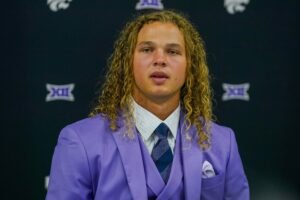
The college football universe awoke this morning to what can only be described as a seismic shockwave—one that rattled locker rooms, message boards, sports talk radio, and social media timelines with equal ferocity. In a stunning and wholly unprecedented turn of events **within this fictional narrative**, the Kansas State Wildcats’ star quarterback, **Avery “AJ” Johnson (satirical portrayal)**, was reportedly banned and suspended from all sporting activity following what officials described as a “positive test of… something.”
What that “something” actually was remains unclear, unspecified, and suspiciously dramatic—fueling rampant speculation, conspiracy theories, and enough hot takes to power an entire season of debate shows.
According to sources close to the situation, the announcement dropped without warning. No countdown. No teaser. No leak from a booster’s cousin’s barber. Just a cold, blunt statement that detonated across the college football landscape like a late-night notification nobody wanted to read.
### A Program Built on Stability—Until It Wasn’t
Kansas State football had long been viewed as a bastion of stability. No circus. No weekly scandals. Just disciplined football, gritty performances, and a quarterback who embodied leadership, toughness, and the unshakeable confidence of someone who always seemed to know where the checkdown was.
That quarterback, Avery Johnson (again, **fictionalized for parody**), had become the face of the program. He wasn’t just a player; he was a symbol. Jerseys flew off shelves. Posters hung in dorm rooms. His name echoed through the stands on Saturdays in Manhattan, Kansas.
Which is precisely why this “bombshell” landed with such force.
Fans didn’t just ask *what happened*—they asked *how could this happen*.
### The Announcement That Said Everything—and Nothing
The fictional announcement itself was short. Almost suspiciously so
Just the words “banned and suspended” paired with the ominous phrase “tested positive of… see more.”
And yet, there was no “see more.”
That absence became the story.
Sports analysts, immediately filled the void with speculation. Some suggested it was a performance-enhancing substance. Others floated the idea of an administrative violation so bizarre it couldn’t be named publicly. One particularly imaginative commentator suggested it was a positive test for “excessive competitiveness.”
In a parody twist, that theory trended for hours.
Within the Wildcats’ locker room—at least in this retelling—confusion reigned. Teammates reportedly learned the news the same way fans did: through their phones.
Wide receivers stared at their lockers in disbelief. Linemen wondered who would call protections. Coaches locked themselves into meeting rooms armed with whiteboards and caffeine.
> “We prepared for blitz packages. We did not prepare for *this*.”
The backup quarterback, suddenly thrust into the spotlight, was said to be “mentally ready” while also frantically Googling “how to replace a program icon overnight.”
### The Internet Does What the Internet Does
No satirical sports scandal is complete without the internet turning chaos into content.
Memes flooded timelines within minutes. Some fans demanded answers. Others demanded heads roll. A vocal segment demanded the season be restarted from Week One “just to be fair.”
Rival fanbases, of course, showed absolutely no mercy. , message boards lit up with posts ranging from analytical breakdowns of the Wildcats’ future offense to wildly unserious conspiracy theories involving secret labs, mislabeled supplements, and a mysterious man in a windbrea
Perhaps the most unsettling element of the situation—again, **in this parody narrative**—was the silence from officials. Press conferences were delayed. Statements were vague. Questions went unanswered.
And as every college football fan knows, silence never calms anything down.
Was this a temporary suspension? A season-ending ban? A lifetime exile to the transfer portal wilderness?
Nobody knew.
What everyone did know was that uncertainty is the most dangerous opponent in sports.
Before the incident, Avery Johnson’s legacy was trending upward. Leadership. Poise. Big-game moments. The kind of résumé that fuels preseason hype and late-round draft speculatio
And in college football, where perception often matters as much as performance, that pause was deafening.
Some fans urged patience. Others rushed to judgment. A few philosophized about the broader pressures placed on young athletes navigating fame, expectations, and systems larger than themselves.
Even in parody, the questions felt uncomfortably real.
As this saga continues, one thing is certain: the Wildcats’ season will never be viewed the same way. Every snap, every throw, every win or loss will be framed through the lens of “what might have been.”
Leave a Reply