
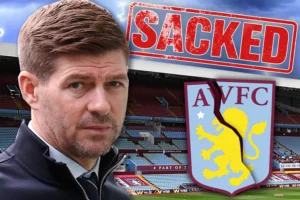
 In the world of global football — more so in the Premier League and the Saudi Pro League — coaches’ relationships, career trajectories, and professional respect often intertwine deeply. When a high-profile former manager such as Steven Gerrard, who has led teams in Scotland, England, and Saudi Arabia, issues a public or reported message directed at another influential coach like Unai Emery, it reflects more than mere etiquette — it may reveal insights into leadership philosophies, managerial pressure, and the footballing culture at one of England’s historic clubs, Aston Villa FC.
Steven Gerrard remains one of the most iconic figures in British football. A Liverpool legend as a player — known for leadership, resilience, and competitive drive — he transitioned into management with high expectations. After a successful spell at Rangers in Scotland, where he won the Scottish Premiership undefeated, Gerrard joined Aston Villa FC in November 2021 in hopes of establishing Villa as a competitive Premier League side. However, his tenure was mixed: Villa struggled for consistency, winning only two of his first 12 league matches in the 2022-23 season, and he was ultimately dismissed in October 2022.
Unai Emery, a highly experienced coach with a remarkable record in European competition, succeeded Gerrard at Villa Park. Emery’s arrival marked a turning point: under his stewardship, Aston Villa achieved its first UEFA Champions League qualification in decades and rose into the upper echelons of the Premier League.
In this landscape of managerial shift and club ambition, any message from Gerrard to Emery resonates not just as personal communication but as symbolic commentary on leadership, legacy, and the evolving identity of Aston Villa.
After departing Aston Villa, Gerrard took on the head coach role at Al-Ettifaq Club in the Saudi Pro League — a league that in recent years has become a hotbed for world-class talent and experienced coaches. Gerrard was appointed in 2023 on a multi-year contract after leaving Villa, bringing with him players like Georginio Wijnaldum and Moussa Dembélé to the Saudi top flight.
His tenure in Saudi Arabia was an intriguing chapter: while showing flashes of tactical growth and leadership, results were inconsistent. By early 2025, the club sat mid-table, and his departure in late January 2025 was confirmed by mutual consent — a decision reflecting both the demanding ambitions of the club and the realities of professional football’s high expectations. Gerrard himself acknowledged the unpredictability of the sport and expressed gratitude for the opportunity and experience.
During his time with Al-Ettifaq, Gerrard’s evolution as a coach — dealing with diverse cultures, elite player expectations, and intense competitive environments — further shaped his managerial voice. It set a stage where a message to a coach like Emery would carry context beyond Villa’s history alone.
Since replacing Gerrard in late 2022, Emery has transformed Aston Villa into one of England’s most exciting teams. The Spaniard has led Villa to consistent European qualification and helped build a tactical identity defined by strategic pressing, solid structure, and adaptability — hallmarks of his coaching philosophy honed across stints at Sevilla, Arsenal, and Villarreal.
Yet Emery’s tenure has not been without challenges. As of early 2026, Villa’s league position has fluctuated, and Emery himself has publicly expressed frustration with factors like injuries and the fierce competitive nature of the Premier League — noting that despite a comfortable points cushion, Villa “are still not contenders” for top five finishes due to the league’s relentless standards.
These comments underscore how pressure at the highest level can shape a coach’s mindset and public posture. For a former peer like Gerrard to weigh in, even indirectly, might reflect deeper respect, competitive empathy, or subtle commentary on football management itself.
Although not grounded in a verified public statement from Gerrard directly to Emery, we can explore a few plausible interpretations of what such a communication might entail and why it would capture the football world’s attention. It could reflect respect for Emery’s accomplishments, acknowledging that while their paths at Villa differed, both sought to bring success to the same club. It could also involve shared insight, with Gerrard discussing managerial philosophies, the balance between squad development and competitive pressure, or broader reflections on leadership — especially with Gerrard’s rich experiences across leagues.
It may also be a message of humility and resilience, reflecting Gerrard’s own reflections about his Aston Villa exit, acknowledging difficult periods, and offering encouragement. It could indirectly comment on multiple realities, such as the cultural differences between the English Premier League and the Saudi Pro League, highlighting how football management challenges are universal yet shaped by specific contexts.
Whether intended as guidance, praise, or shared insight, a message from Steven Gerrard to Unai Emery carries symbolic weight precisely because both coaches have become part of Aston Villa’s recent history — one as a high-profile managerial appointment, the other as the architect of the club’s modern resurgence. Such a message would not just be about football strategy — it would speak to how leaders in sport manage expectations, legacy pressures, cultural transitions, and professional growth. For fans, analysts, and aspiring coaches globally, it would underline the continuing narrative that football is as much about human leadership as it is about tactics and results.
—
Leave a Reply